
A rent receipt that mentions an incorrect amount, a wrong period, or an inaccurate tenant name is not just an administrative issue. This document, although not mandatory as long as the tenant does not request it, serves as enforceable proof of payment. An uncorrected error can block a rehousing file, suspend housing assistance, or weaken the landlord’s position in case of litigation.
Erroneous receipt and tenant prejudice: the underestimated legal risk
An inflated rent amount on the receipt skews the effort rate ratio used by subsequent landlords or surety organizations. Conversely, an undervalued amount may suggest a partial unpaid rent when cross-referenced with the lease.
Recent rental management guides remind us that the tenant can claim damages before the judicial court when the receipt error causes them concrete harm: rental application denied, housing assistance suspended, compromised access to credit. Correction alone is not sufficient if the damage has already occurred.
For the landlord, a symmetrical risk exists. Issuing a receipt indicating full payment while a balance remains due significantly weakens their case in the event of proceedings for unpaid rent. The tenant can use the document to contest the debt. We recommend never issuing a receipt stating full payment while a balance exists: a partial payment receipt is the only appropriate document in this situation.
Before taking any steps, it is useful to know how to correct an error on the receipt by precisely identifying the nature of the anomaly, as the procedure differs depending on whether it is a mistake in amount, identity, or period.

Identifying the type of error on the rent receipt
Not all errors have the same severity or correction procedure. We distinguish three main categories.
- Amount error: the rent excluding charges, the provisions on charges, or the total do not match the terms of the lease. This case is most common during an annual revision that is poorly reflected or a faulty data entry in management software.
- Identification error: misspelled tenant name, incomplete housing address, or absent lease number. This category poses problems when compiling a rental file or applying for housing assistance, where every mention must exactly match the identity documents.
- Period error: the receipt covers a month different from the one actually paid, or overlaps a period already receipted. This type of anomaly often occurs in shared housing management when the issuance of receipts is not synchronized with account movements.
Particular case of rental management software
Automated management platforms generate receipts from the lease data recorded during the initial setup. An input error at this stage replicates on each monthly document. The correction then does not concern an isolated receipt but the entire set of receipts issued since the original error. Some tools allow batch cancellation and reissuance, while others require correction document by document.
Steps to obtain the correction of a receipt from the landlord
The tenant sends a written request to the owner or manager. A registered letter with acknowledgment of receipt remains the safest form, but an email with a read receipt is sufficient in most cases if the rental relationship is smooth.
The letter must precisely identify the document in question (period, issue date), describe the observed error, and attach a copy of the lease to support the requested correction. The landlord has no legal reason to refuse the correction of a receipt containing a proven material error.
Response time and follow-up
No text sets a precise legal deadline for correction. In practice, we observe that a period of fifteen working days constitutes a reasonable benchmark before following up. If the landlord does not respond, the tenant can refer the matter to the departmental conciliation commission, competent for rental disputes under the law of July 6, 1989.
In the case of management by a real estate agency, the request is addressed to the manager, who forwards it to the owner for validation. The agency assumes its professional responsibility if the error originates from its own management.
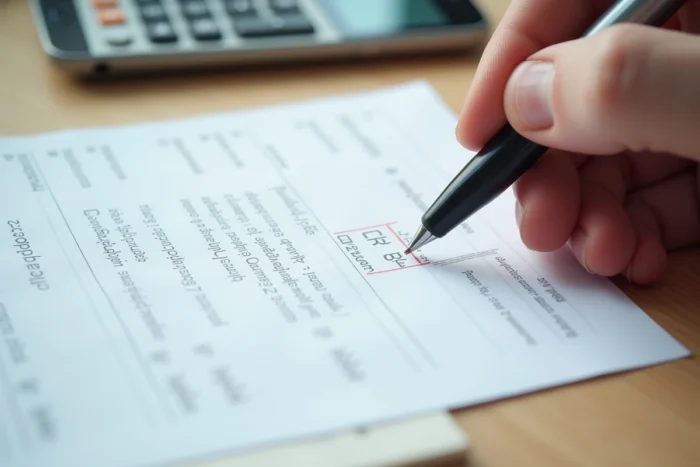
Correction of a rent receipt: best practices for the landlord
The rectified document completely replaces the erroneous receipt. It is not an amendment or a partial correction. The new receipt bears the same period, mentions the correct amounts of rent and charges, and specifies the actual payment date.
We recommend adding the mention “cancels and replaces the receipt issued on [date]” to eliminate any ambiguity in case of subsequent control or dispute. Keeping the erroneous original in the lease file remains a useful precaution: its destruction could be interpreted as an attempt to conceal.
PDF model and mandatory mentions
The PDF format remains the standard for issuance, whether the receipt is generated by management software or written manually. The mentions to systematically verify during reissuance are as follows:
- Name and address of the landlord or agent
- Name of the tenant as it appears on the lease
- Complete address of the housing
- Relevant period (month and year)
- Breakdown between net rent and provisions on charges
- Date and method of payment recorded
The absence of any of these mentions does not nullify the receipt, but it reduces its evidential value if the document is produced in an administrative or judicial file.
A landlord managing multiple properties has an interest in centralizing the issuance of receipts in a single tool rather than juggling between spreadsheet and Word template. Reducing the risk of error at the source remains the best strategy, well before correction afterward.