
A wedding typically involves about ten service providers, a five-figure budget, and several months of coordination. Organizing a stress-free wedding relies less on enthusiasm and more on a method: securing regulatory and logistical constraints before focusing on decoration or the dress.
Marriage file at the town hall: the legal deadlines that dictate the timeline
Before choosing a venue or caterer, the administrative calendar sets an unyielding framework. Articles 63 to 76 of the Civil Code require the submission of a marriage file to the town hall, followed by the publication of the banns for ten days. Ignoring this deadline is like building a timeline on sand.
The file includes identification documents, proof of residence, birth certificates issued within the last three months (or six months for a certificate issued by a consulate), and the list of witnesses. Some town halls require a preliminary appointment with the civil registrar, which adds several weeks to the process.
When one of the future spouses is a foreign national, the file becomes more complex: certificate of custom, sworn translations, and sometimes a preliminary hearing. Submitting this file at least two months before the desired date avoids unnecessary stress. Those who wish to prepare their wedding with 123 Mariages can check the availability of service providers against this administrative calendar from the start.

Booking the reception venue: a tighter window than one might think
The reception venue market is experiencing a unprecedented saturation for the past twenty years. With about 247,000 weddings celebrated in France in 2024, summer Saturdays are now booked twelve to eighteen months in advance. For some sought-after venues, particularly in the PACA region, the lead time extends to twenty-four or even thirty months.
This observation changes the traditional hierarchy of steps. The venue is not an aesthetic choice to be refined leisurely: it is the first scarce resource to secure, even before the caterer or photographer. A couple that sets their date without checking the venue’s availability finds themselves negotiating from a position of weakness, forced to postpone or lower their expectations.
How to choose between multiple venues
Visiting three or four sites is sufficient, provided you compare based on concrete criteria:
- Actual capacity in seated meal configuration, not just in standing cocktail, as the difference can exceed one-third of the seats
- Time and noise constraints imposed by the municipality or neighbors, which affect the choice of DJ or band
- On-site or nearby accommodation, a decisive factor for the comfort of guests traveling from afar
The venue budget often represents the largest expense. Validating this amount early allows for realistic calibration of the rest of the budget.
Wedding budget: structuring the items before signing any quotes
A wedding budget is not just a single figure. It breaks down into interdependent items: venue, caterer, drinks, attire, decoration, photography, entertainment, stationery, and a contingency margin of at least five to ten percent of the total.
The most common mistake is signing for an expensive venue without having estimated the caterer, which often represents a comparable expense. The couple then discovers that the remaining budget no longer covers the desired level of service for the meal. Structuring a spreadsheet with columns for “estimated,” “quote received,” and “paid” makes each decision transparent.
Often underestimated items
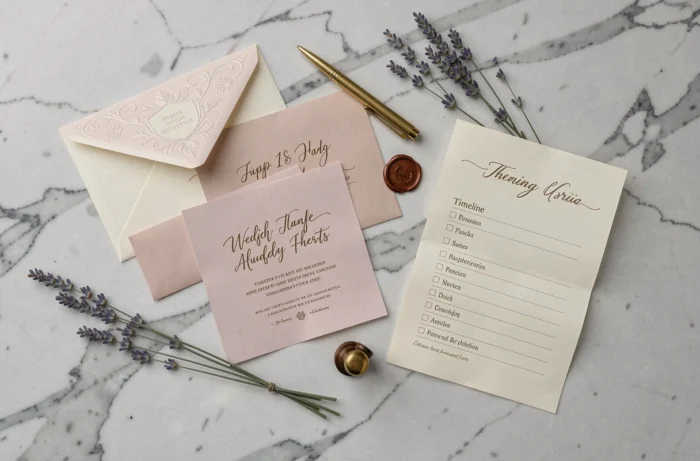
Stationery (invitations, menus, seating plan, ceremony booklet) and transportation costs (shuttles for guests, travel for service providers) are frequently overlooked in initial estimates. Similarly, coordination on the day itself, whether entrusted to a wedding planner or a willing friend, deserves its own budget line if the couple truly wants to experience the day without stress.
Guest list and choice of service providers: two decisions that follow each other
The guest list determines almost everything else. A wedding for fifty people does not require the same venue, caterer, or budget as a reception for one hundred and fifty guests. Setting a realistic number of guests before requesting quotes avoids costly back-and-forth in terms of time and energy.
Once this number is stabilized, the selection of main service providers can begin: caterer, photographer, DJ or band, florist. Meeting two to three professionals per category, checking their references, and comparing their quotes on an identical basis (same number of guests, same duration of service) provides a solid decision-making foundation.
Coordinating without micromanaging
The stress of preparations often comes from the multiplication of contacts. Centralizing communication in a shared document (spreadsheet or project management tool) where each service provider has their line with their contact information, deadlines, and deposits paid reduces mental load. A monthly check-in with key providers is sufficient in the months leading up to the wedding, followed by a weekly check-in in the last month.
Decoration, the secular ceremony, choosing the dress or suit, the rings: these elements naturally come into play once the logistical framework is established. Wanting to choose floral decoration before confirming the venue is like furnishing an apartment before signing the lease.
Organizing a wedding relies on a logical sequence: legal constraints, venue, budget, guest list, service providers. Each locked step frees up bandwidth for the next. The joy of preparations emerges when the foundations are stable.