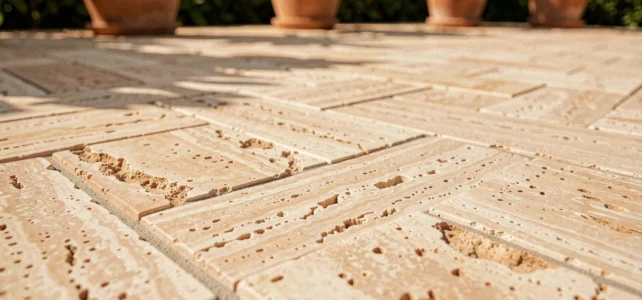
On a south-facing terrace, the choice of flooring often comes down to porcelain stoneware, reconstituted stone, and natural stone. Travertine paving frequently comes up in discussions, and for good reason: it is a limestone formed by mineral precipitation in hot springs, primarily extracted in Italy and Turkey.
Its shades range from light beige to golden brown, with unique veining on each piece. It is used both for garden paths and around pools, as well as for interior flooring.
Slip Resistance and Standards: The Criteria Often Overlooked in Product Sheets
When selecting paving for the outdoors, the first question is not the color. It is slip resistance. Travertine installed around a pool or on a terrace exposed to rain must meet specific anti-slip requirements.
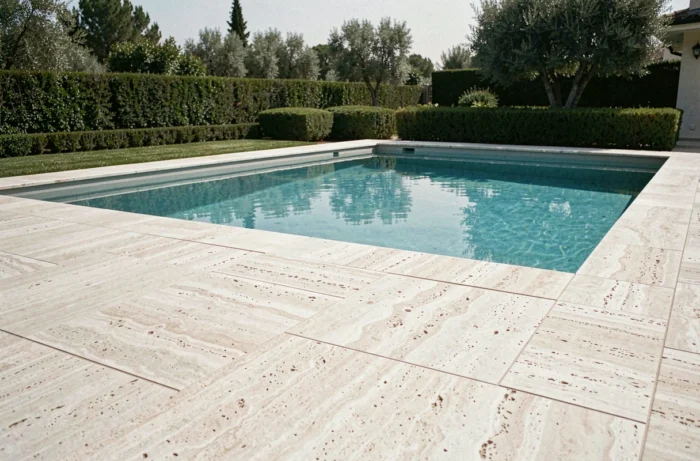
Outdoor areas exposed to water are classified with high slip resistance levels. Pool surrounds follow a distinct logic, that of barefoot passage, which imposes an even stricter classification. A brushed or aged finish travertine naturally offers a rough surface suitable for these constraints. In contrast, polished travertine becomes slippery as soon as it is wet and is not suitable for uncovered outdoor areas.
You can learn everything about travertine paving in terms of aesthetics, but without checking the appropriate anti-slip rating for the installation area, you risk a dangerous flooring. Always request the technical data sheet with the R10, R11, or R12 classification before ordering.
Installing Travertine Paving: DTU and Freeze Constraints
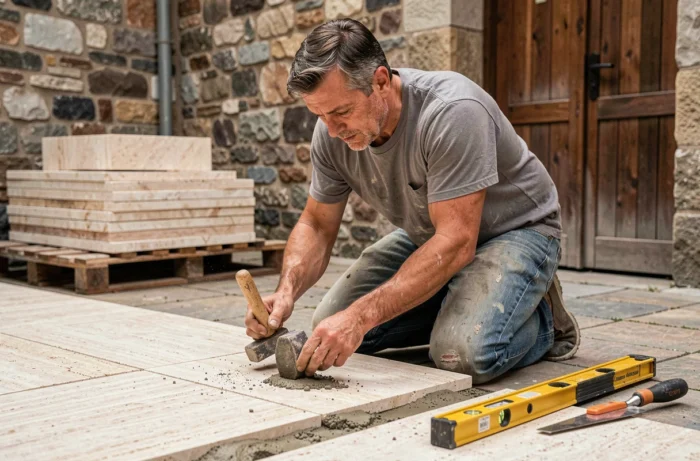
Installing outdoor travertine paving is not something to improvise. The rules for implementing natural stones refer to specific technical documents. According to a technical note published in August 2026, glued installation falls under NF DTU 52.2, while attached installation (on facades or vertical supports) falls under NF DTU 55.2, amended in July 2025.
Freeze resistance is checked according to the NF EN 12371 standard. This point is crucial if you live in a region where temperatures drop below zero for several weeks a year. Non-certified freeze-resistant travertine can crack during the first winter.
Points to Check Before Installation
- The support must be perfectly level and draining, especially on a sloped terrace. A lack of flatness causes water stagnation that accelerates degradation.
- The joints must be suitable for the stone’s expansion. A joint that is too tight will crack in frost, while a joint that is too wide will accumulate moss.
- The thickness of the paving determines its mechanical resistance. For a vehicle-accessible path, choose a thickness significantly greater than that of a simple pedestrian paving.
Feedback on durability varies by region: travertine installed in the south of France does not face the same constraints as in Alsace. Checking the freeze certification of the delivered batch remains the most reliable reflex.
Water-Repellent and Oil-Repellent Treatment: Protecting the Porosity of Travertine
Travertine is a porous stone. This gives it its authentic appearance, with its characteristic small cavities. It is also what makes it vulnerable to grease stains, wine, coffee, and moss deposits.
The market for natural stone maintenance is evolving towards combined water-repellent and oil-repellent treatments in a single product. These “2-in-1” solutions allow the stone to continue breathing while simultaneously protecting it against water and greasy substances. A simple water-repellent treatment is no longer sufficient if you install travertine near a barbecue or outdoor kitchen.
The application is done on clean, dry stone, usually a few days after installation to allow the joints to dry completely. Renewal every two to three years maintains protection at a correct level, depending on exposure and traffic.
Regular Maintenance of Outdoor Travertine: Mistakes to Avoid
A recent Italian guide emphasizes a fundamental point: outdoor travertine is not a “maintenance-free” stone. Its porosity requires regular and, above all, appropriate cleaning. The wrong reflex is using a pressure washer too close to the surface, which digs into the natural cavities and weakens the stone.
Cleaning Suitable for Travertine
For regular maintenance, use lukewarm water and a neutral soap (diluted black soap or Marseille soap). Acidic products (vinegar, descaler) attack the limestone and cause irreversible white stains.
- Clean with a soft brush or broom, never with a metal sponge that scratches the surface.
- Rinse thoroughly to avoid soap deposits in the pores.
- Treat lichens and moss with a specific product for natural stone, not with bleach which discolors and weakens travertine.
- Quickly blot grease or wine stains before they penetrate the stone.
Well-maintained travertine retains its appearance for decades. The key is consistency: a light monthly cleaning is better than an aggressive annual stripping.
Choosing the Format and Finish of Travertine According to Use
Travertine comes in several formats and finishes that cater to distinct uses. For a pool surround, a coping format with rounded edges and anti-slip brushed finish is preferred. For a garden path, small format pavers in Roman opus create a highly sought-after irregular look.
Common finishes include aged travertine (textured surface, softened edges), brushed (slightly scratched for grip), and polished (smooth, reserved for indoors). The choice of finish directly affects the safety and longevity of the flooring based on its location.
In terms of price, travertine is positioned in a higher range than standard tiles but remains competitive compared to other natural stones like granite or slate. The investment is justified by the durability of the material and the aesthetic added value it brings to an outdoor or indoor layout.
Travertine remains a material that rewards those who take the time to properly prepare their project: check the slip resistance standard, adhere to installation DTUs, apply an appropriate protective treatment, and maintain regularly. Under these conditions, it is a stone that withstands the years without losing its character.