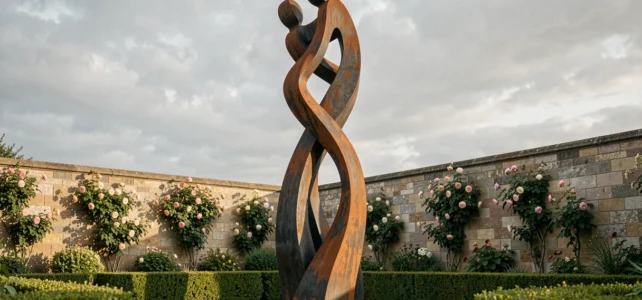
A giant outdoor sculpture is defined by a height or span that far exceeds human scale, designed to withstand the elements and conceived as a structuring element of the landscape. Far from being just an ornament placed on a lawn, these pieces alter the perception of volumes, create lines of escape, and impose a visual rhythm on the entire garden.
Kinetic and luminous sculptures: pieces that redefine the contemporary garden
Recent trends in garden art show a clear progression of kinetic sculptures, these structures whose moving elements react to the wind or a discreet motor. Their interest goes beyond visual spectacle: they introduce a temporal dimension into a static space. The garden changes appearance depending on the strength of the wind, the time of day, and the season.
In parallel, sculptures incorporating LEDs or optical fibers transform a mundane flowerbed into a nocturnal installation. Combined with mirror or reflective surfaces, they visually enlarge the space and capture the sun’s reflections during the day. For a modest-sized garden, this optical effect is more effective than a multiplication of plants.
The choice of giant sculptures for the garden incorporating these technologies requires planning for discreet electrical supply or an autonomous solar system, which directly influences the chosen location.
Materials for XXL outdoor sculptures: resin, metal, stone
The material determines both the durability, logistical weight, and aesthetic rendering of a large sculpture. Three families dominate the market.
- Corten steel and welded metal: Corten steel develops a protective rust patina that evolves over time. Sculptures made from recycled mechanical parts (chains, gears) offer a raw finish, suitable for contemporary or industrial gardens. Metal supports large formats without complex internal structures.
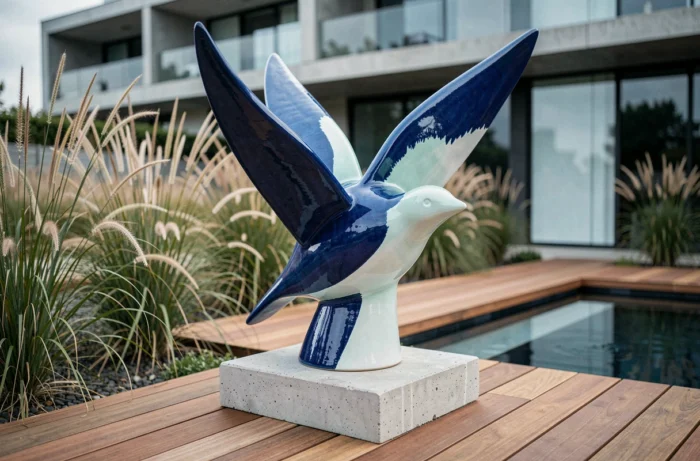
- High-density resin: lighter than stone or metal, resin allows for very detailed finishes (animal textures, bright colors). It withstands frost, UV rays, and humidity well, which explains its popularity for animal sculptures or large figures.
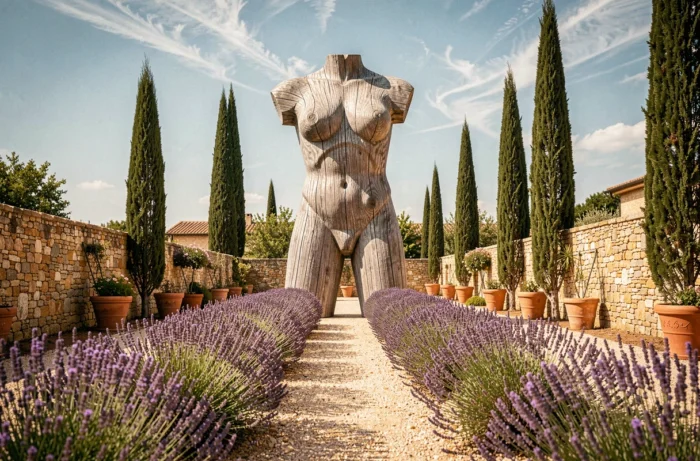
- Natural stone and fiber-reinforced concrete: stone remains the classic choice for heritage gardens. Fiber-reinforced concrete, less expensive, mimics stone while allowing for bolder shapes. These materials are heavy, necessitating a slab or suitable base.
The choice is not limited to taste. A clay soil that swells in winter will poorly support a stone sculpture weighing several hundred kilos without specific foundations. The type of soil conditions the material as much as the style.
Functional giant sculptures: when art becomes garden furniture
The most striking trend in 2025-2026 concerns monumental sculptures with dual functions. A sculptural bench in steel that structures a pathway. A monumental frame positioned to frame a perspective of the landscape. A minimalist geometric fountain that combines a water point and an artistic piece.
These hybrid objects respond to a concrete demand: to maximize every square meter of the garden without sacrificing aesthetic ambition. A sculpture-bench replaces both a garden furniture piece and an ornament. The garden gains coherence because each element serves two roles.
For artists and manufacturers, this approach imposes a more demanding specification. The sculpture must support the weight of a user, withstand daily use, and maintain its aesthetic qualities despite wear. Anti-corrosion finishes and surface treatments become decisive quality criteria.
French regulations for large garden sculptures in protected areas
Installing a large sculpture in a private garden generally does not require any specific authorization. The situation changes radically if the land is located in a remarkable heritage site or near a historical monument.
In these areas, any visible modification to the exterior appearance of a property may require a prior declaration of works, or even an opinion from the Architect of the Buildings of France. The Heritage Code governs these situations. Checking the classification of the plot before any order avoids a costly administrative refusal.
The decree of July 27, 2026, concerning measures to simplify local public action has made adjustments to the procedures applicable to local authorities, but for individuals in protected areas, consulting the ABF remains the rule. A reflective kinetic sculpture, for example, may be deemed incompatible with the heritage character of a site, even if it is placed in a private garden not visible from the public road.
Staging and exhibiting a giant sculpture in a garden
The placement of a large sculpture follows a logic of landscape composition. Two concrete principles guide the positioning.
The first concerns lines of sight. A sculpture placed at the end of a perspective (pathway, trimmed hedge, body of water) captures the gaze and adds depth to the garden. Positioned in the center of an open space, it risks overwhelming the rest of the plant decor.
The second concerns natural and artificial lighting. A reflective metal sculpture oriented due south produces dazzling reflections in summer, which can be as distracting as it is appealing. Ground-level grazing lighting reveals textures and volumes at dusk, while overhead lighting flattens the reliefs.
Maintenance directly depends on the material and exposure. A resin sculpture placed under a deciduous tree requires regular cleaning to avoid tannin deposits. Corten metal, designed to rust, requires no treatment but can permanently stain the stone or concrete below if runoff water is not channeled.
A garden transformed into an outdoor art gallery ultimately rests on a balance between artistic ambition and technical constraints. The soil, local regulations, orientation, and material form an inseparable whole, and it is their coherence that makes the difference between a sculpture placed and an integrated sculpture.