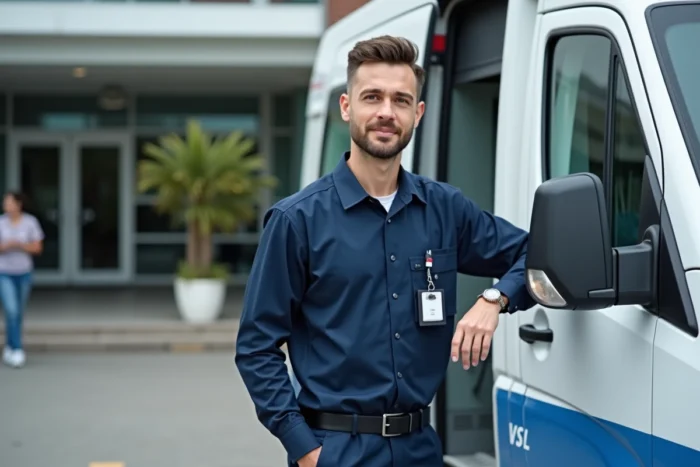
Transporting a patient to a care center or a specialized consultation is the daily routine of a light medical vehicle driver. The profession of VSL driver is appealing due to its human dimension and quick access to the job market, but it requires meeting specific conditions before getting behind the wheel.
Medical fitness and criminal record: the filters before any VSL training
Before discussing qualifications, two checks either block or open the door. The first is physical fitness. A doctor approved by the prefecture must validate that the candidate is fit to work in medical transport. This assessment particularly focuses on vision, hearing, and the absence of any medical conditions incompatible with prolonged driving.
The second is the criminal record. The B2 bulletin must not contain any mention incompatible with the transport of vulnerable persons. A conviction for driving under the influence of alcohol or drugs, for example, can close the door.
These two steps are often overlooked in retraining pathways. Prefectural medical fitness is a prerequisite for enrolling in training. It is better to complete this in advance to avoid wasting time and money.
To understand how each prerequisite fits into the curriculum, a detailed guide on the VSL driver training on Tous un Job explains the administrative and educational steps in order.
Ambulance auxiliary or state diploma: what title to drive a VSL

Two titles allow you to drive a VSL. The first, and the most common for beginners, is the ambulance auxiliary certificate. The second is the state diploma of ambulance driver (DEA), which is more comprehensive and also allows for driving category A ambulances.
The ambulance auxiliary certificate
This certificate is prepared over a short duration, generally a few weeks. It covers first aid techniques, hygiene, patient handling, and the rules of medical transport. It is legally sufficient to be employed as a VSL driver in a medical transport company.
The candidate must hold a valid category B driving license for at least three years (or two years in the case of accompanied driving). They must also provide the prefectural medical fitness certificate and a level 1 emergency response training certificate (AFGSU 1), often included in the ambulance auxiliary curriculum.
The state diploma of ambulance driver
The DEA represents a higher level of qualification. Its training lasts several months and includes internships in hospital settings and medical transport companies. In addition to driving VSLs, it allows for the care of patients on stretchers in ambulances.
The DEA opens up career advancement opportunities towards ambulance driving and business management. A VSL driver holding the DEA can then progress to an ambulance driver position and eventually create their own medical transport company.
CPF funding and remaining costs: what has changed since 2024
Funding for training is an expense that many underestimate. Since 2024, any training funded by the Personal Training Account requires a mandatory financial contribution from the trainee, regardless of the amount of available CPF rights.
This remaining cost also applies to ambulance auxiliary training eligible for CPF. In practice, even with sufficient CPF balance, the candidate will have to pay an additional amount.
Another point to watch: since February 2025, non-certifying training for business creation is no longer fundable by the CPF. For a future VSL driver considering self-employment, this means that the “business creation” part will need to be funded through other means (personal funds, regional aid, Pôle emploi).
Other funding options exist depending on the profile:
- Job seekers can apply for individual training assistance (AIF) through France Travail, subject to approval of their application.
- Employees in retraining can mobilize a professional transition project (PTP, formerly CIF) with their regional CPIR.
- Some regional councils offer scholarships or partial funding for jobs in demand in the healthcare and medico-social sectors.
Prefectural approval and vehicle: obligations after training
With the diploma or certificate in hand, the journey is not over. To practice, one must be affiliated with a medical transport company holding a license issued by the Regional Health Agency (ARS). This license certifies that the company complies with standards regarding qualified personnel, compliant vehicles, and continuity of care.
A salaried driver joins an already licensed company. A driver wishing to become independent must obtain their own license, which requires adhering to a regulatory ratio between state-certified ambulance drivers and ambulance auxiliaries within the workforce.
Compliance of the light medical vehicle
The VSL must meet specific requirements: regulatory signage (six-pointed blue cross), basic sanitary equipment, and documented regular maintenance. A non-compliant vehicle results in the suspension of the license.
For independents, the regulatory trend is moving towards increased scrutiny. In the adjacent VTC sector, a law that came into effect in 2026 prohibits providing third parties with one’s registration in the operator registry, under penalty of removal and a three-year ban on re-registration.
This logic of combating undeclared work and the increased vigilance duty of matchmaking platforms indicates a likely tightening for all passenger transport, including medical transport.
Becoming a VSL driver remains an accessible path for those who anticipate each step: medical fitness, certificate or diploma, appropriate funding, and then licensing. The profession is hiring, and administrative rigor upfront can save several months on the actual installation timeline.