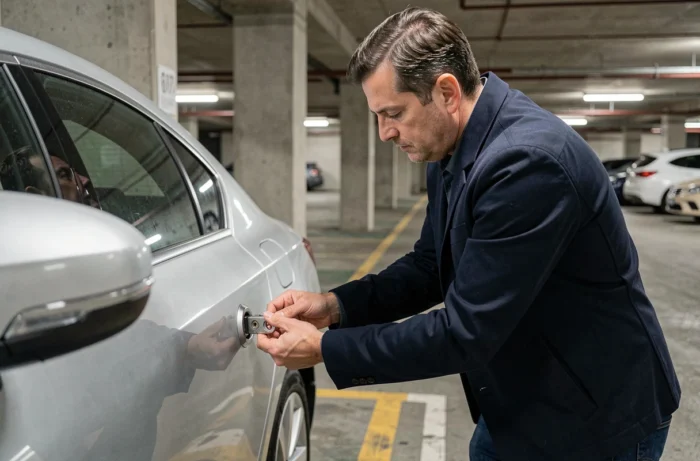
A vehicle parked on the street or even in a residential parking lot remains exposed. Theft techniques have evolved: the vast majority of thefts today occur without visible break-ins, through electronic hacking. Effectively protecting your car against theft requires understanding these new methods and implementing concrete mechanical and digital countermeasures.
OBD Port and Key Signal: the Two Vulnerabilities Exploited by Thieves
You may have noticed that your recent car unlocks remotely, without turning a key? This convenience relies on a radio exchange between the key and the vehicle. Thieves have understood this well.
The technique known as “mouse jacking” involves hacking the vehicle’s electronic systems to start it without a key and without damage. Specifically, a device captures the signal from your key, even through a wall, and relays it to an accomplice stationed near the car. The vehicle “thinks” the key is present and unlocks.
The other entry point is the OBD (On-Board Diagnostics) port, located under the dashboard. Mechanics use it for engine diagnostics. A thief equipped with the right tool can connect to it and reprogram a new key in just a few minutes. This port is accessible without any disassembly on almost all models.
These two vulnerabilities explain why physical protection devices remain relevant, even on a modern vehicle loaded with electronics. To stay updated on alerts related to vehicle theft, a useful resource is: https://www.alerte-auto.com/, which lists real-time reports.
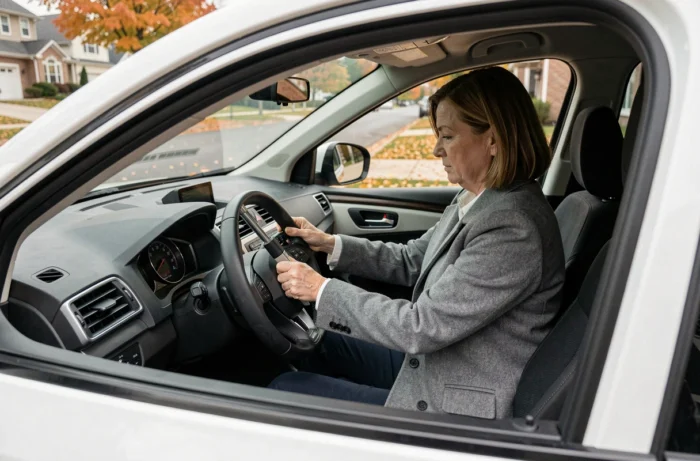
Protecting the Key and OBD Port: Two Simple Actions Against Electronic Theft
Blocking the radio signal from your key is the first countermeasure. An anti-wave case (sometimes called a Faraday pouch) prevents any signal relay as long as the key is stored inside. The principle is simple: the metallic fabric cuts off the waves between the key and the outside.
Always store your key in this case as soon as you are home, especially if your vehicle is parked near your entrance. This is where the risk of signal capture is highest.
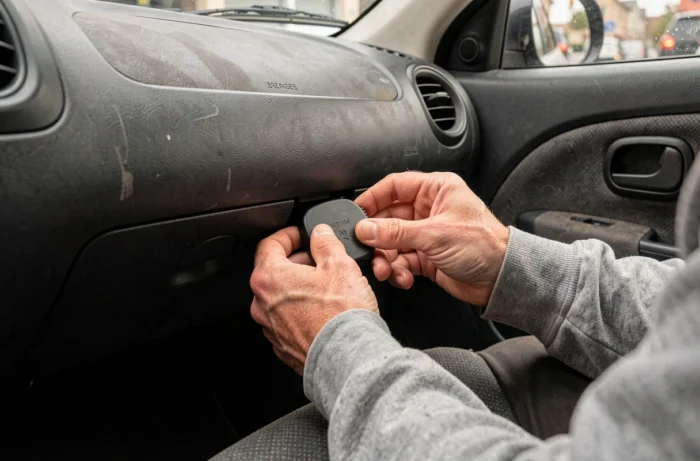
For the OBD port, there are physical protections: a locked cover or a security OBD box that blocks access to the connector. Without access to this port, the thief cannot reprogram a key. Some of these devices require a specific key or code to be removed.
What These Protections Do Not Cover
An anti-wave case does not protect against traditional break-in theft (window breaking, lock forcing). And an OBD cover does not prevent the key signal relay. These two protections are complementary, not interchangeable.
Mechanical Lock and GPS Tracker: the Duo That Slows Down and Locates
Although electronic theft dominates the statistics, mechanical devices remain a real deterrent. A thief who spots a visible steering wheel lock through the windshield may choose to move on to another vehicle. The time it would take to cut or force it poses a risk of being spotted.
Why combine mechanical and digital? Because each layer of protection adds time and complexity for the thief:
- The steering wheel lock prevents steering the vehicle even if the ignition has been hacked. Hardened steel models resist cutting tools better.
- The autonomous GPS tracker, hidden in the cabin or under the body, allows for locating the vehicle after a theft. Autonomous models run on their own battery and do not depend on the vehicle’s electrical circuit, making them invisible to OBD diagnostics.
- An additional electronic immobilizer system, independent of the original one, adds a step that standard hacking devices cannot bypass.
No single device is sufficient. It is the accumulation that discourages: a thief rarely spends more than a few minutes on a vehicle protected by multiple systems.
Theft of Spare Parts: a Distinct Risk That Requires Different Reflexes
Competitors often talk about the theft of entire vehicles, but the theft of parts (headlights, mirrors, wheels, catalytic converters) is skyrocketing in certain urban areas. Data from SSMSI for 2025 shows that these thefts are concentrated in about a hundred cities in France, with significant variations from one city to another.
This type of theft often requires just a screwdriver and a few minutes. The parts then end up on the black market, sold at cut prices.
Reducing Exposure to Parts Theft
Parking plays a direct role. A closed, well-lit parking lot under video surveillance measurably reduces the risk. If you do not have a garage, prefer a busy and well-lit spot rather than a quiet, secluded street.
For catalytic converters, there are bolted protection plates. They do not make theft impossible, but they add noise and time, two deterrent factors. Locking nuts on the wheels complement this logic for the tires.
Cost of Theft Claims and Insurance Trade-offs
SSMSI figures for 2025 reveal a paradox: the number of stolen vehicles has decreased by about 9% compared to 2024, with 125,200 vehicles stolen. At the same time, the average cost of a theft claim has significantly increased over the past ten years.
The targeted vehicles are newer, better equipped, and therefore more expensive to replace or repair. This trend changes the game when choosing your insurance coverage. A solid theft guarantee, with an appropriate deductible, deserves to be compared to the cumulative cost of security equipment.
A steering wheel lock, an anti-wave case, and an OBD cover represent a modest budget. An autonomous GPS tracker costs more, sometimes with a monthly subscription. But faced with a deductible of several hundred euros and the loss of use of the vehicle during the weeks of processing the claim, preventive investment often remains more advantageous than just insurance coverage.
The best protection combines complementary layers: neutralized key signal, locked OBD port, visible mechanical lock, hidden tracker. Each device alone has its limits. Together, they transform your vehicle into a low-profit target for a hurried thief.