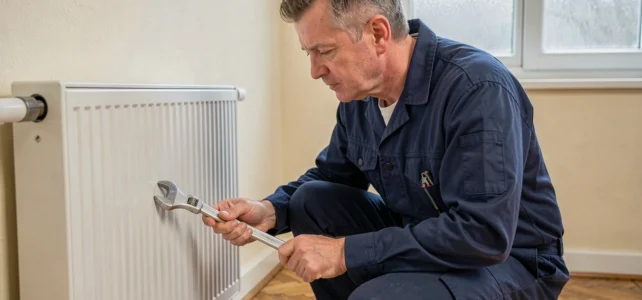
A radiator that stays cold on a January morning, a puddle under the boiler, an error code flashing on the control screen: these situations often occur without warning. In Brussels, where most homes operate with sometimes aging gas boilers, knowing how to react to a leak or a heating failure prevents a minor incident from turning into an expensive disaster.
Before picking up the phone, a few simple actions can limit damage and make the technician’s job easier when they arrive.
Pressure, valve, and circuit breaker: checks before any call
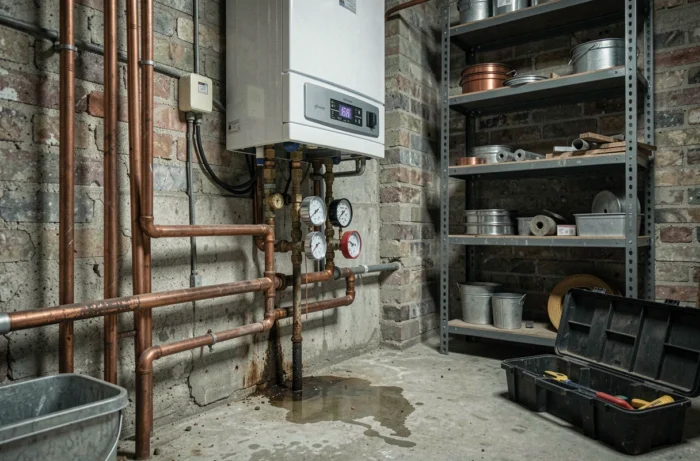
Have you noticed the pressure gauge on your boiler? This small dial indicates the water circuit pressure. On most domestic installations, the green zone is between 1 and 1.5 bar. A pressure that is too low prevents proper water circulation in the radiators. Sometimes, increasing the pressure via the filling valve (usually located under the boiler) is enough to restart the system.
If the pressure drops again quickly, it is a sign of a leak somewhere in the heating circuit. In this case, close the filling valve and turn off the boiler.
In the event of a visible leak, the first reflex is to shut off the water supply at the nearest stop valve. Place a container under the leak to limit damage to the floor or ceiling of the lower floor. For gas boilers, if you detect a suspicious smell, immediately turn off the gas valve and ventilate the room before taking any further action.
By consulting the services of Le Comptoir Web, you will find a detailed description of the security steps suitable for Brussels installations.
PEB Control in Brussels: the obligation many discover at the time of failure
A heating failure often highlights an administrative issue as much as a technical one. In Brussels, all gas or oil boilers must undergo a periodic PEB control carried out by a technician accredited by Brussels Environment. The frequency depends on the fuel: every two years for gas, annually for oil or solid fuel.
The owner remains legally responsible for this control, even when the lease assigns regular maintenance to the tenant. A failure to control exposes one to administrative penalties from Brussels Environment.
Why is this point related to the failure? Because the PEB certificate mentions the condition of the installation, combustion settings, and any safety defects. A technician responding to an emergency will often request this certificate. If it does not exist or is expired, the repair may become complicated: some heating engineers refuse to restart an installation whose last control is not up to date.
Tenant or owner: who pays for what
Regular maintenance (cleaning the burner, replacing small wear parts) generally falls to the tenant. Structural repairs (leaking heat exchanger, boiler replacement) are the responsibility of the owner. The PEB control is always the owner’s responsibility, unless there is an explicit contrary clause in the lease.
If in doubt about the distribution, the site bruxelles-j.be details the respective obligations regarding housing maintenance.
Emergency heating repair: avoid pitfalls on the bill
Calling an emergency heating technician in Brussels on a Sunday evening costs significantly more than a scheduled appointment during the week. The SPF Economy reports a continuous increase in complaints regarding repair services, particularly for overcharging during emergency interventions.
Before approving an intervention, a few precautions can reduce the risk of unpleasant surprises:
- Request a quote or at least a price range over the phone before the visit. A serious professional will agree to provide an estimate for a basic diagnosis.
- Check that the technician is accredited by Brussels Environment for interventions on gas installations. Accreditation ensures specific training in appliance safety.
- Demand a written breakdown of the bill: travel, labor, replaced parts. Refuse any global bill without itemization.
- If you have a maintenance or heating assistance contract with your energy supplier, call them first: repairs are often included or offered at a reduced rate.
Gas boiler replacement in Brussels: what regulations now require
When the failure leads to a diagnosis of replacement, the question of the type of new equipment arises. The Brussels-Capital Region has initiated a gradual ban on new gas, oil, and coal boilers. Since September 2021, the installation of coal or oil systems has already been prohibited in new and renovated buildings under certain conditions.
For gas, the milestones are becoming clearer. The regional direction is pushing towards heat pumps, heat networks, or hybrid solutions. If your gas boiler breaks down irreparably, the heating engineer may still replace it with a condensing gas model in most current cases, but installation conditions are changing rapidly.
Anticipate rather than suffer
Rather than waiting for the definitive failure to discover these constraints, check the age of your boiler. Beyond about fifteen years of service, the likelihood of breakdowns increases and spare parts become difficult to find. Planning a replacement outside of emergency situations allows for comparing quotes, choosing the technology suitable for the building, and benefiting from regional energy grants.
The up-to-date PEB control also plays a concrete role here: the certificate indicates the combustion efficiency. A significantly degraded efficiency compared to current standards serves as an objective signal to consider replacement before the winter failure.
A leak or heating failure in Brussels is managed better when controls are up to date, safety gestures are known, and the choice of technician is prepared in advance. Keeping the PEB certificate accessible, noting the number of an accredited heating engineer, and knowing the location of the gas valve: these three simple reflexes make the difference between an unpleasant evening and a real disaster.