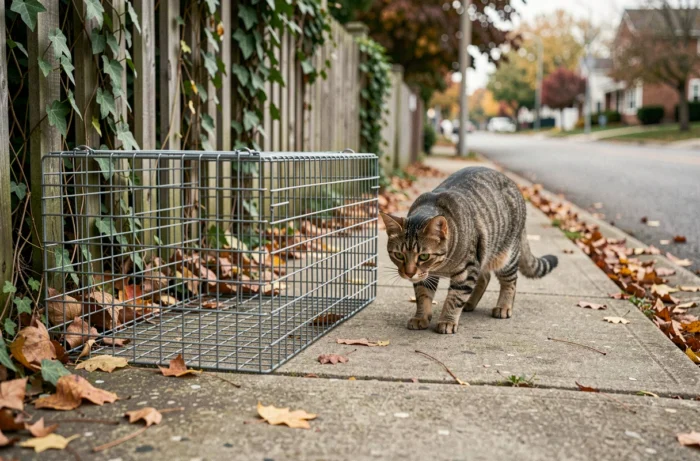
The trapping of stray cats relies on a precise sequence of technical gestures. A poorly adjusted cage, a poorly positioned bait, or inappropriate timing compromise the capture and increase the animal’s stress. Here, we detail the operational points that general guides often overlook.
Adjustment of the trigger mechanism: the variable that conditions everything
The majority of trapping failures stem from a poorly calibrated trigger mechanism. On models with a central plate, sensitivity depends on the tension of the retaining hook. If too loose, the door closes at the slightest draft or insect passage. If too tight, a kitten or weakened cat does not trigger the closure.
We recommend testing the plate before each session by placing a weight equivalent to that of a thin cat (two to three kilos is sufficient). The triggering should be clear, without any bounce of the door. A bounce gives the animal a fraction of a second to retreat, making it much more wary of any cage afterward.
On double-entry cages, check that both doors close simultaneously. A slight offset creates a draft that the cat perceives as a possible exit. It then loops inside instead of calming down, increasing the risk of injury to its snout or claws.
To choose a trapping cage to capture cats suitable for your area, prefer models where the plate covers at least two-thirds of the interior width. Narrow plates force the cat to walk exactly in the center, which reduces the capture rate for individuals that hug the walls.
Bait and food conditioning before capture
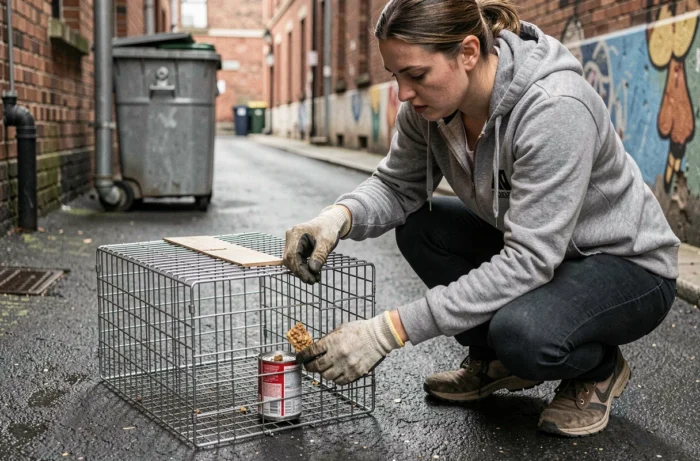
A successful trapping begins several days before setting the cage. The food conditioning of the target cat is the longest phase of the protocol. Placing food in the same spot at a fixed time creates a ritual that the animal quickly integrates.
The typical sequence follows a progressive logic:
- For three to five days, place the food uncovered, without the cage, to establish the feeding point as a safe zone.
- Then introduce the open cage (doors blocked) with food placed at the entrance, then increasingly deeper inside over two to three days.
- On the day of capture, place the bait behind the trigger plate and arm the mechanism. Use a strongly scented food (tuna, sardine, grilled chicken) that the cat already associates with the ritual.
Changing bait on the day of capture is a common mistake. The cat identifies the unusual smell and refuses to enter. We observe that the most wary individuals sometimes require a full week of conditioning before they accept to fully enter the cage.
Cage covering and post-capture stress management
A cat trapped in an uncovered cage can seriously injure itself within minutes. Panic causes projections against the mesh, attempts to bite the metal, and a state of shock that complicates subsequent veterinary examination.
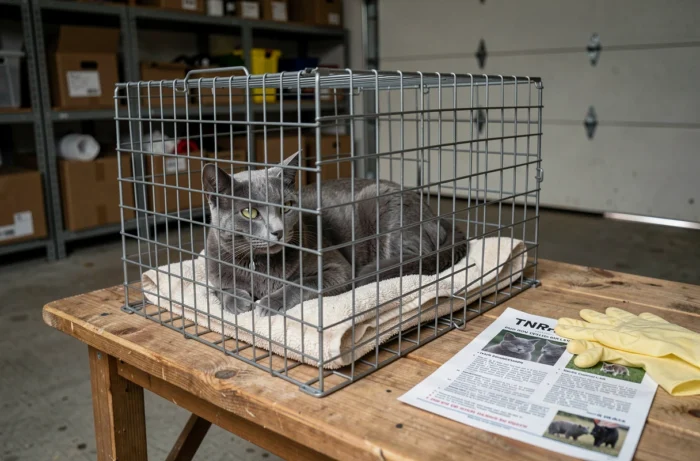
As soon as the door closes, completely cover the cage with a thick sheet or an opaque cover. Darkness immediately reduces agitation. Do not lift the fabric to check the cat’s condition, even briefly. Each exposure to light restarts the panic cycle.
Transport to the veterinarian should be done with the cage covered, in a stable position in the vehicle. Avoid the trunk if ventilation is insufficient, especially in hot weather. The internal temperature of the cage rises quickly under a cover, hence the need to maintain air circulation around the fabric without uncovering the animal.
Maximum duration of cage confinement
Never leave a cat in a trap cage for more than a few hours without intervention. If the capture occurs in the evening and the veterinary appointment is the next morning, place the cage in a quiet, temperate location, away from other animals. Slip a small bowl of water accessible through the mesh without opening the door.
Regulatory framework for trapping and municipal protocol
The trapping of stray cats falls within a framework established by the Rural and Maritime Fishing Code. Several municipalities now organize official campaigns that follow a five-step protocol: spotting, capturing, sterilizing, identifying with a microchip, and then releasing at the place of life. This return to the site is an obligation frequently ignored by individuals who move captured cats to other neighborhoods.
Approved associations often intervene in partnership with the town hall, which covers all or part of the veterinary costs. The state has also mobilized 30 million euros for animal protection associations, including a specific allocation of 3 million euros dedicated to the sterilization of stray cats. This funding allows local organizations to lend trap cages to individuals involved in feeding.
Feeding a stray cat without a sterilization campaign
Regularly feeding a stray cat without having it sterilized can lead to a fine. Feeding creates a de facto responsibility towards the animal. Municipalities that formalize trapping campaigns generally require declared feeders to participate in the identification and sterilization of the cats they feed.
Trapping remains the central tool for managing stray feline populations. The success of a capture depends less on the equipment than on the rigor of food conditioning, the adjustment of the mechanism, and the immediate management of post-capture stress. A poorly trapped cat becomes an untrappable cat for months.