Cellular polycarbonate allows a very large portion of infrared radiation to pass through. Under a polycarbonate roof exposed to the sun, the indoor temperature can rise by fifteen to twenty-five degrees above the outside temperature as soon as the first summer heat arrives. Cooling this type of roofing requires acting on three distinct levers: blocking radiation before it reaches the panel, evacuating accumulated heat, and limiting thermal transfer to the living space.
Ventilated air gap and insulation under polycarbonate roofing: the underestimated thermal lever
Most guides address solar film or blinds as the first response to overheating. Before getting to that, the most effective physical principle for an already installed polycarbonate roof remains the creation of a ventilated air gap between the panel and the inhabited space.
In practical terms, this involves installing insulation (false ceiling or second skin) a few centimeters below the existing roof. This air gap acts as a buffer: it slows down heat transmission by convection and radiation. Several craftsmen recommend using materials with high thermal inertia for this insulation, such as wood fiber or cellulose wadding, which delay the peak of indoor heat by several hours.
This type of solution remains reversible. It can be complemented by tips for cooling a roof on L’Atelier du Bricolage that detail possible combinations of insulation and surface treatment.
The insulation has an often-overlooked advantage: it also protects the polycarbonate from accelerated aging due to UV exposure, as the panel is no longer directly exposed to stagnant hot air on the inside.
Thermal film and cool roof paint on polycarbonate: compatibility and limits
The special polycarbonate thermal film is the most common solution for blocking solar radiation before it penetrates the panel. High-performance films reject a very significant portion of solar energy and can lower indoor temperature by five to eight degrees depending on the conditions.
Their lifespan reaches ten to fifteen years when installed correctly. Professional installation ensures the absence of bubbles and durable adhesion on the cellular structure, whose textured surface complicates bonding.
Reflective paint: a strict protocol
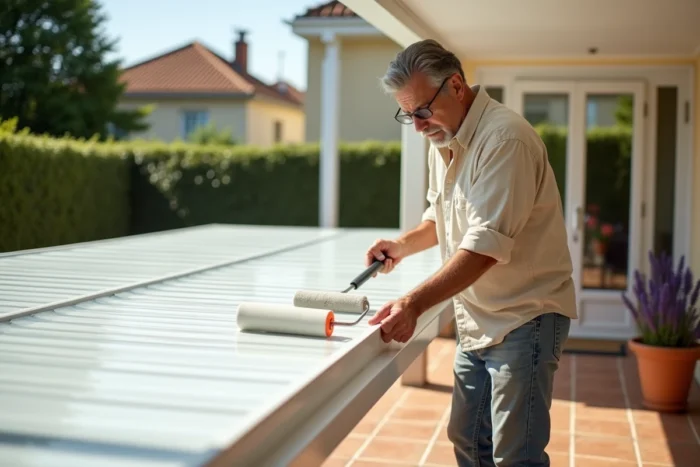
So-called “cool roof” paints are now offered in formulations compatible with plastic roofs, including veranda and pergola polycarbonate. The principle is simple: a white or light coating that reflects solar radiation instead of absorbing it.
The difficulty lies in the preparation protocol. Without thorough cleaning and degreasing of the surface, the paint will crack or peel within a few months on existing polycarbonate. It must also be applied in dry weather, on a completely dry panel, and the number of layers prescribed by the manufacturer must be respected.
- The thermal film can be removed without leaving a trace: it is the quintessential reversible solution, suitable for tenants or recent roofs that one does not wish to modify
- The reflective paint offers a more durable treatment but commits the surface: a poor choice of product or preparation compromises adhesion over several years
- Both solutions can be combined with interior insulation to maximize thermal inertia
Structural shading above the polycarbonate roof: fabric, vegetation, and panels
Acting on radiation before it even touches the polycarbonate remains the most radical strategy. A shading structure placed above the roof simultaneously reduces direct radiation and heat storage in the panel.
Three common options stand out:
- Shade sails tensioned a few dozen centimeters above the roof create a ventilated buffer zone. They can be dismantled in autumn and do not alter the structure
- Shade panels (wood trellis, rigid screens) fixed to a lightweight frame provide permanent shading while allowing air circulation
- Vegetation above the polycarbonate (climbing plants on an open pergola, for example) combines shade and evapotranspiration, lowering the ambient temperature around the roof
Structural shading works even better when combined with a light coating on the panel. Feedback from roofers confirms that the combination of shading and reflective coating significantly reduces overheating compared to either solution in isolation.
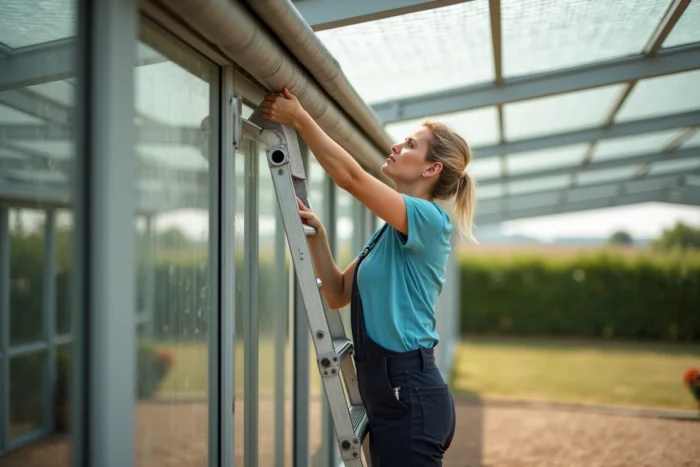
Ventilation under polycarbonate roofing: controlling openings according to the hours
Ventilating a space covered by polycarbonate is not just about opening windows. A cross breeze, with a low inlet and a high outlet, utilizes natural convection: warm air rises and escapes, replaced by cooler air drawn in from below.
Several recent guides emphasize a technical point often overlooked: open widely only during cool hours (early morning, late evening) and close during peak sunlight hours. During the day, leaving openings wide under a polycarbonate roof means drawing in already hot outside air, which exacerbates overheating instead of limiting it.
For enclosed verandas or pergolas, mechanical ventilation of the plenum (the space between the insulation and the panel) allows for the evacuation of stored heat without dispersing it into the room. A simple extractor positioned at a high point is sufficient in most configurations.
Replacing polycarbonate: when reversible solutions are no longer enough
When the polycarbonate roof has aged (yellowing, loss of transparency, micro-cracks), films and paints adhere poorly, and insulation by lining no longer compensates for the material’s degradation. Replacing it with polycarbonate panels with integrated UV protection or solar control glazing then becomes the most coherent response.
Next-generation panels incorporate treatments that filter a much broader portion of the infrared spectrum than older models. The additional cost is justified over time by significantly improved thermal comfort and reduced maintenance.
Before replacing, checking the condition of the supporting structure remains a step not to be overlooked. More efficient polycarbonate installed on a framework deformed by accumulated heat over the summers will not solve the underlying problem.