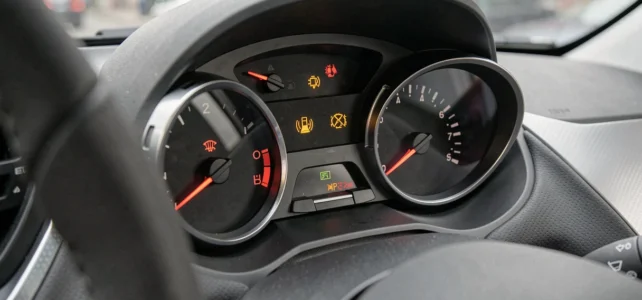
We are cruising along the ring road, and an orange symbol appears on the dashboard of the Peugeot 208. The classic reflex: search the glove compartment for a manual that has never been opened. However, the dashboard lights of the Peugeot 208 follow a simple logic, as long as you know a few concrete indicators to distinguish a serious alert from just a piece of information.
Dashboard light on Peugeot 208 and technical inspection: the link that no one checks in time
Before even looking for the meaning of a pictogram, one should ask a practical question: will this dashboard light cause a problem at the next technical inspection?
Since the latest road safety reforms in France, a permanently lit ABS, ESP, or airbag light is classified as a major failure. The direct consequence: mandatory re-inspection within two months. We regularly see 208 owners discover this point on the day of the inspection, even though the light has been flashing for weeks without causing any noticeable symptoms while driving.
The particulate filter (DPF) light also falls into this logic. The anti-pollution control thresholds have tightened with the introduction of fine particle (PN) measures. On the 208 diesel BlueHDi, an ignored DPF light for too long can mean a clogged filter, which leads to exceeding emission standards and a refusal at the technical inspection.
For a more detailed explanation of the Peugeot 208 dashboard lights, the subject deserves to be explored engine by engine.

Red lights on Peugeot 208: those that require immediate engine shutdown
The color code is the first sorting to do. A red light on the 208 is an order, not a suggestion.
Red engine oil light
It represents an oil can. When it lights up while the engine is running, the oil pressure is insufficient to lubricate the engine. Turn off the ignition as soon as possible. Continuing to drive, even a few kilometers, risks causing engine seizure, which often costs more to repair than the value of the vehicle on used 208s.
Coolant temperature light
A thermometer in water, in red. The engine is overheating. Pull over, turn off the engine, and wait for it to cool down before opening the expansion tank cap (risk of burns). On the PureTech three-cylinder engines, this light sometimes appears due to a faulty thermostat or a worn water pump.
Red battery light
This light indicates that the alternator is no longer charging the battery while driving. The car continues to operate on the battery’s reserve, but for a limited time. Head to a garage without turning on unnecessary consumers (air conditioning, heated seats).
Orange lights on Peugeot 208: quick diagnosis before panicking
Orange signals an anomaly that does not require immediate stopping but does require intervention in the following days. The nuance is important: you can drive cautiously, but not indefinitely.
- Orange engine light (MIL): the ECU has detected a fault in engine management. On PureTech engines, common causes include a faulty ignition coil or a defective pressure sensor. A diagnostic scan allows reading the specific fault code.
- ESP/ASR orange light: the stability control system signals an anomaly. The vehicle remains usable, but without electronic assistance in case of loss of grip, which radically changes behavior on wet roads.
- Tire pressure light (TPMS): one or more tires are below the pressure threshold. Check cold with a gauge. On the 208, this light also activates after a wheel change if the system has not been reset.
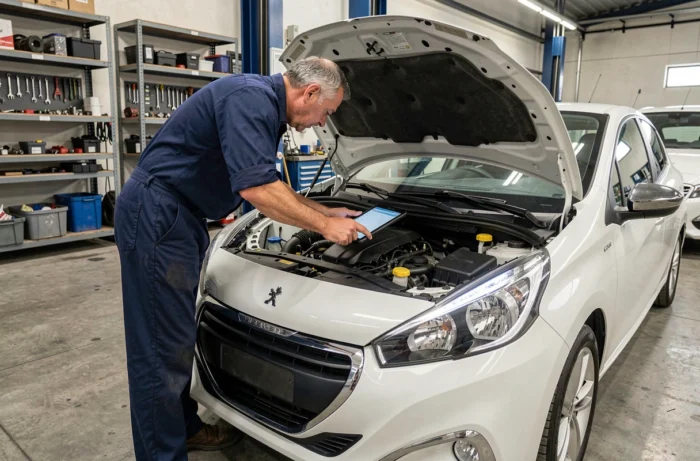
- DPF light (diesel only): the particulate filter requires regeneration. Drive at a sustained speed on a highway for about twenty minutes. If the light persists, the filter is likely too clogged for passive regeneration.
Green and blue lights on the 208: information, not an alert
These lights confirm that a system is active. They signal no problem.
The green light for low beam headlights, the cruise control light, or the “READY” indicator on the electric e-208 fall into this category. On the electric version, the green “READY” indicates that the vehicle is ready to start, equivalent to the engine noise on a combustion engine.
The blue light for high beam is the only one to note: it reminds you that the high beams are activated, and that you risk dazzling the oncoming vehicle.
Specifics of the Peugeot e-208: lights related to high voltage battery
The e-208 shares most of its lights with the thermal versions but adds alerts specific to electric powertrains.
An orange turtle-shaped light signals a power limitation due to a very low battery level or a battery temperature out of range. Slow down and head to a charging station.
The red charging light indicates a fault in the high voltage system. In this case, do not attempt to charge the vehicle yourself: contact Peugeot assistance. Feedback varies on this point depending on the configurations of charging stations, but caution is advised with a high voltage circuit.
ADAS lights on recent versions
The 208 equipped with driving aids display additional indicators: lane departure warning, emergency braking, blind spot monitoring. These lights flash to alert, not to signal a malfunction. However, a fixed ADAS light indicates a dirty sensor or a system malfunction, often resolved by cleaning the windshield at the camera level.
The dashboard of the 208 concentrates a lot of information in a compact space. Remembering the color logic (red, orange, green) covers the vast majority of situations. For persistent lights, the diagnostic scan remains the most reliable tool: it translates a vague pictogram into a fault code that can be used by a mechanic.