A leaking dishwasher seal, a refrigerator that frosts for no reason, a toaster silent for three days. Before ordering a new appliance, you can often resolve the issue with minimal tools and the right reflexes. Maintaining and repairing your household equipment at home helps extend their lifespan, reduce energy bills, and avoid premature replacement.
Common appliance breakdowns: what can be fixed without spare parts
In France, it is estimated that one in two appliances returned to customer service is not actually broken. No spare parts are needed to restore it: clogged hose, dirty filter, limescale buildup. The majority of toaster breakdowns, for example, are caused by crumbs stuck in the mechanism.
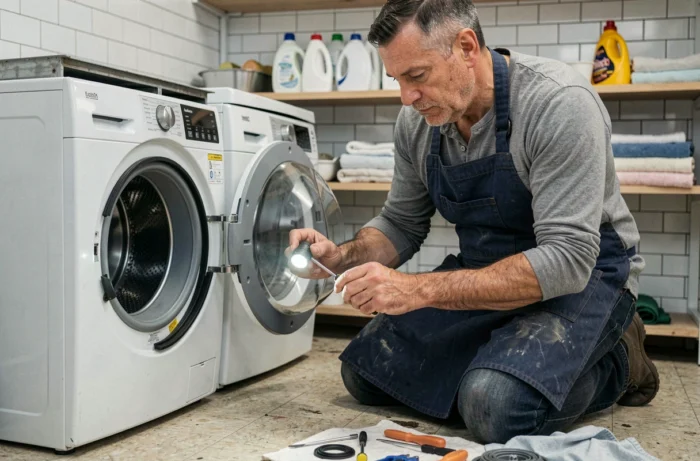
Before disassembling anything, start with a simple diagnosis. The washing machine is no longer spinning: check that the drain filter is not blocked by an item left in a pocket. The vacuum cleaner is losing power: remove the filter, gently tap it, rinse it if the model allows. These actions take a few minutes and require no special tools.
To go further in identifying a breakdown, reliable resources can be found on the SAV 35 website, which lists troubleshooting guides tailored to the main household appliances.
The reflex to adopt: always check the filter, hose, and power supply before concluding a breakdown. In most cases, the problem is mechanical and superficial, not electronic.

Descaling and cleaning: home maintenance that prevents breakdowns
Limescale is the first silent enemy of appliances that use water. Washing machines, dishwashers, kettles, coffee makers: all suffer from gradual buildup that increases their energy consumption and degrades their performance.
Frequency and method according to the appliance
You do not maintain a washing machine like a coffee maker. Here are the concrete actions that make a difference:
- Washing machines and dishwashers: run a high-temperature empty cycle with white vinegar or a suitable descaler once a month. Clean the washing machine door seal after each use to prevent mold.
- Kettle and coffee maker: fill with a water-vinegar mixture (half and half), heat, let sit for about twenty minutes, and rinse thoroughly. The frequency depends on the hardness of the water in your home.
- Refrigerator: defrost the freezer compartment as soon as the layer of frost exceeds a few millimeters. Clean the back grille (condenser) once or twice a year to maintain the compressor’s efficiency.
- Oven and microwave: for the oven, a paste of baking soda applied to the walls and left for several hours dissolves cooked grease. For the microwave, a bowl of lemon water heated for a few minutes loosens splatters.
A limescale-covered appliance consumes more energy and breaks down faster. Regular descaling is the most cost-effective maintenance action you can take at home.
Tumble dryer: a special case
The water collection tray must be emptied after each cycle. The lint filter should be cleaned regularly. If the model has a condenser, it should be rinsed under running water every two to three months. Neglecting these steps shortens the motor’s lifespan and increases the risk of overheating.
Right to repair: what regulations change for your appliances
Since the transposition of the European directive on the right to repair, manufacturers are legally obliged to offer a repair at a reasonable price and within a reasonable time, even after the end of the legal warranty, as long as the repair is technically possible. This obligation extends for a period of five to ten years after purchase, depending on the type of product.
In practice, before attempting DIY repairs or repurchasing, you can demand an official repair proposal from the manufacturer and compare it with the price of an independent repairer or the cost of a home repair.
Extended warranty in case of repair
Another notable change: for goods covered by the legal warranty of conformity, choosing repair over replacement extends the warranty by an additional twelve months. A washing machine that breaks down at eighteen months and is repaired thus benefits from a total protection extended to thirty-six months.
This rule changes the decision-making logic. Repairing an appliance under warranty is no longer just an ecological gesture; it is also a financial strategy that extends coverage. Feedback on this point varies by retailer, but the legal framework is clear.
Home repair: the limits to know before starting
Not everything can be repaired with a screwdriver and an online video. Some interventions require specific skills or present real risks.
- The internal electrical circuits of an oven or induction cooktop should not be handled without training. The risk of electrocution is real, even with the appliance unplugged (charged capacitors).
- The refrigerant gas circuit of a refrigerator or air conditioner requires professional tools and certification. Any refrigerant fluid leak is harmful and regulated.
- Counterfeit or non-compliant spare parts can worsen the breakdown and void the remaining warranty. Check the exact reference on the device’s technical documentation.
Knowing how to recognize the limits of home repair avoids accidents and extra costs. For interventions that go beyond cleaning or replacing an accessible part, calling a professional remains the safest solution.
Regular maintenance, proper diagnosis, and knowledge of your rights regarding repairs cover the vast majority of situations encountered with appliances. A cleaned filter every month, scheduled descaling, and checking seals before winter: these simple actions delay the moment when you really need to reach for your wallet.